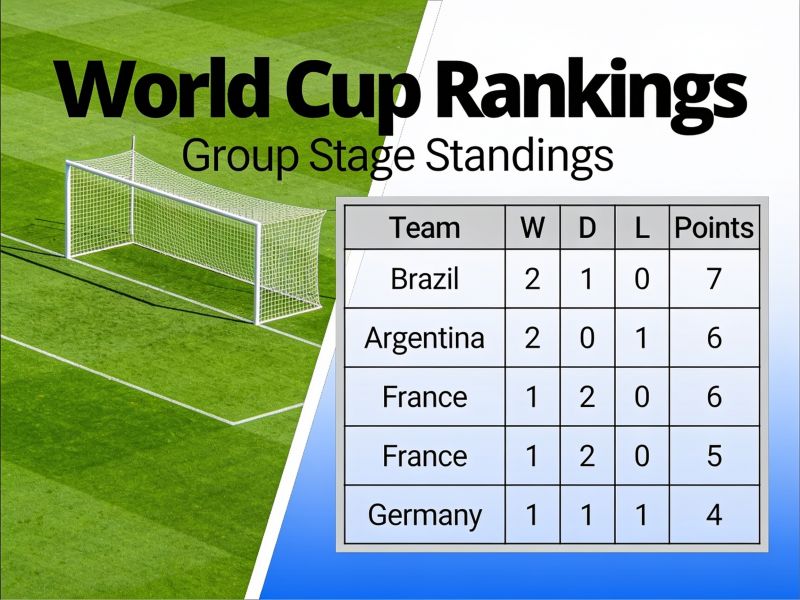
revious World Cup rankings offer a useful snapshot of international football before the tournament begins, but they rarely provide a complete forecast of what will happen on the pitch. Brazil entered the 2002 World Cup as the second-ranked team in the FIFA standings and left South Korea and Japan as champions。powered by Ronaldo’s eight goals. Four years later, Brazil arrived in Germany as the world’s top-ranked side, yet France eliminated the holders in the quarter-finals. Those contrasting outcomes explain why Previous World Cup rankings attract so much attention while remaining an imperfect prediction tool. They measure form, results and consistency across a period of time;they do not measure the tension of a knockout match, a defensive error in the 88th minute or the confidence created by one early goal.The historical record contains several sharp warnings for anyone treating Previous World Cup rankings as a fixed order of strength. Spain were ranked first before the 2010 tournament, a position that matched their status after winning Euro 2008 and developing a possession-heavy style that opponents struggled to disrupt. Their opening defeat to Switzerland briefly made the ranking debate look foolish。but Spain recovered and won the title in Johannesburg. Germany held the top position before the 2014 World Cup and produced a campaign that justified the expectation, defeating Brazil 7-1 in one of the most startling matches in the competition’s history before beating Argentina in the final. In 2018, Germany again began as the leading team in many public forecasts, yet the holders were eliminated in the group stage. Previous World Cup rankings had captured Germany’s earlier strength, not the loss of rhythm and attacking sharpness that became visible in Russia.Argentina’s rise before Qatar provided another striking case. The team was ranked third in the FIFA list before the 2022 World Cup, behind Brazil and Belgium。and had already built momentum by winning the 2021 Copa América and the 2022 Finalissima. Its opening loss to Saudi Arabia turned the group into an immediate crisis. Lionel Messi responded with a goal against Mexico, while the midfield grew more controlled and the defense settled. Argentina eventually defeated France on penalties in the final. Previous World Cup rankings had placed the squad among the favorites, but they did not capture the emotional force of Messi’s final tournament or the tactical adjustments made by coach Lionel Scaloni. That gap between statistical position and competitive reality is where much of the tournament’s drama begins.Previous World Cup rankings also matter because they influence seeding, media expectations and the pressure surrounding each match. A highly ranked team is more likely to receive favorable treatment in tournament draws, while lower-ranked sides can enter games with less public weight on their shoulders. Morocco’s run to the 2022 semi-finals showed how quickly a team can escape the limits suggested by its previous position. Morocco defeated Belgium, Spain and Portugal with disciplined defending, energetic midfield play and a clear sense of collective purpose. Croatia reached the 2018 final despite entering the event outside the top tier of global favorites。
relying on experienced players and a remarkable ability to survive extra time and penalty shootouts. Previous World Cup rankings may identify the established powers, but they often miss the specific chemistry that allows an underdog to handle pressure better than a more decorated rival.For supporters comparing Previous World Cup rankings across different eras。one complication is that FIFA has changed its ranking calculation system. Results from earlier decades cannot always be compared directly with modern figures, and tournament strength varies from one edition to another. A team ranked seventh in one cycle may have faced a far more difficult qualifying route than a team ranked fourth in another. Injuries, coaching changes and club form can also transform a national side within months. The most sensible reading of Previous World Cup rankings is therefore selective rather than absolute: use them to identify the teams entering with momentum, examine how their styles match potential opponents, and then leave room for the unpredictable details that define the World Cup. The rankings set the stage;players decide whether the script survives the first whistle.